|
DNA Vials
As part of the promotion for the October 2004 release of the mass-market paperback edition of Slatewiper, I prepared small vials of dehydrated DNA for a variety of uses including some which were mailed to science writers.
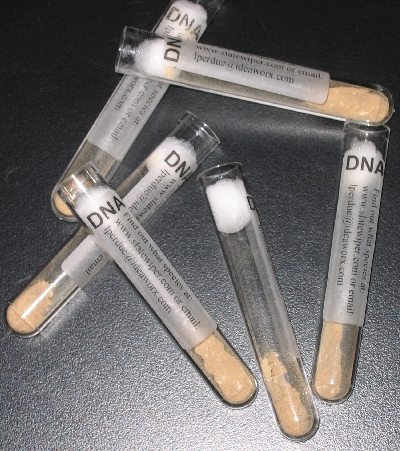
The main reason for the
mailing is for people to come face-to-face with the stuff of life. It's
cause for thought that the awesome power to define who we are and how
we differ from each other and every living thing comes in such a
remarkably banal package.
I considered sending samples of my own DNA,
extracted from epithelial cells and amplified with the Perkin Elmer
GeneAmp PCR machine that is part of my garage DNA laboratory. I decided
not to do this primarily because I was concerned that some people would
take offense at the shipping of human DNA. I had a smaller concern
dealing with my own genetic privacy, but that was not as large a worry.
Ultimately, the DNA I shipped was purchased from LabDepot
which I also use for a lot of the supplies and equipment I donate to my
son and daughter's school. This particular DNA from LabDepot comes from
Herring sperm and it offers yet another advantage over self-extracted
DNA: it has a beige color to it rather than the white powder I produce
in my home DNA lab. Should something happen in the mail, it's far
better to have some beige powder than white.
I've tried to package the DNA in a way to minimize spills or breakage. The vial is styrene plastic rather than glass and the stopper, while it looks like cotton, is a synthetic, re-usable plastic foam specifically made for laboratory equipment. When shipped, this package goes in a padded envelope with a "Fragile" sticker.
DNA is Harmless
But in case something does happen and the DNA spills out, it's harmless.
Indeed, the standard Material Safety Data Sheet (MSDS) for DNA shows that it is ranked somewhere between pure water (H2O) and table salt (NaCl). See below for all the details.
MSDA Data:
Water: https://fscimage.fishersci.com/msds/59997.htm
DNA: https://fscimage.fishersci.com/msds/20595.htm
Table salt: https://fscimage.fishersci.com/msds/21105.htm
|